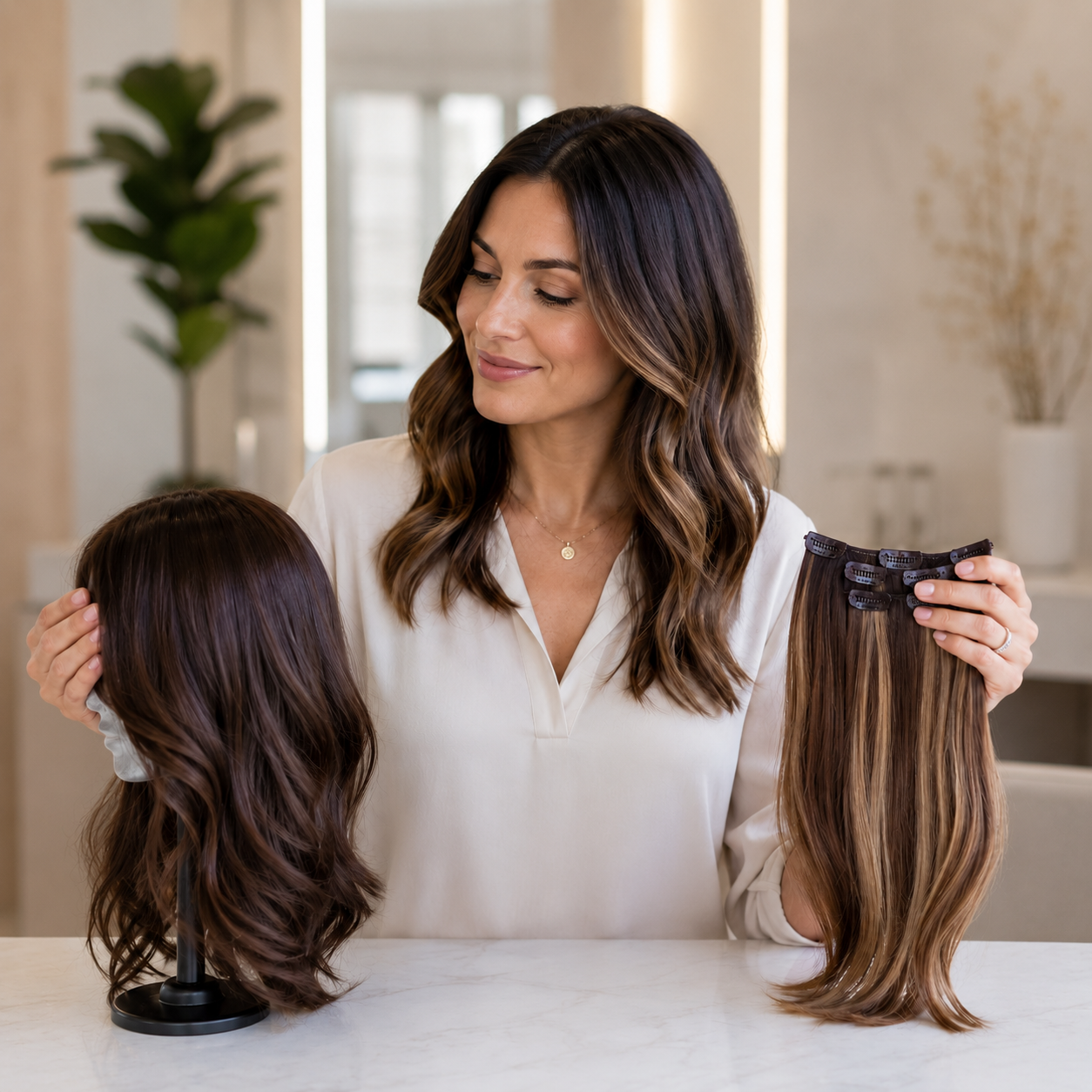
Choosing between the two isn’t simply a matter of deciding which one looks better. The right option depends on your amount and pattern of hair loss, the areas you want to cover, your lifestyle, styling preferences, comfort, and how much coverage you need.
At Toronto Wig Studio, we help clients explore both wigs and hair toppers and determine which solution best suits their individual needs. In this guide, we’ll explain the key differences between wigs and hair toppers and help you understand which option may be right for you.
What Is a Wig?
A wig is a hair system designed to cover the entire head. Depending on the construction, a wig can provide complete coverage regardless of how much natural hair you have underneath.
Wigs are available in many different styles and constructions, including:
- Human hair wigs
- Synthetic wigs
- Lace-front wigs
- Monofilament wigs
- Hand-tied wigs
- Traditional-cap wigs
- Medical wigs
- Custom wigs
Because a wig covers the entire head, it can be an excellent option for people experiencing significant hair loss or those who want a completely new hairstyle.
Wigs can also be used by people who have plenty of natural hair but simply want the convenience of changing their hairstyle without cutting, colouring, or chemically processing their own hair.
What Is a Hair Topper?
A hair topper is a hairpiece designed to cover a specific area of thinning hair rather than the entire head.
Hair toppers are particularly useful when hair loss is concentrated around areas such as:
- The crown
- The top of the head
- The part line
- The front hairline
- The temples
Unlike a full wig, a topper is usually worn over your existing hair and secured using clips, integration techniques, or other attachment methods depending on the design.
The goal is to blend the additional hair with your own natural hair to create the appearance of greater density and coverage.
For someone with thinning hair but substantial hair remaining around the sides and back, a topper can sometimes provide exactly the coverage they need without requiring a full wig.
The Biggest Difference: Coverage
The easiest way to understand the difference between a wig and a topper is to think about coverage.
A wig provides full-head coverage.
A topper provides targeted coverage.
If you’re experiencing hair loss across most or all of your scalp, a wig may be the more practical option.
If your hair is primarily thinning at the crown or along the part, a topper may provide sufficient coverage while allowing you to continue using your own hair.
This distinction is one of the most important factors to consider when choosing between the two.
Wig vs. Hair Topper: A Quick Comparison
| Feature | Wig | Hair Topper |
|---|---|---|
| Coverage | Entire head | Specific areas |
| Best for | Significant hair loss or complete style change | Thinning or localized hair loss |
| Uses existing hair | Usually not necessary | Usually yes |
| Styling | Wide range of options | Blends with existing hair |
| Hairline coverage | Can provide full coverage | Depends on topper design |
| Maintenance | Depends on material and construction | Often requires blending and styling |
| Attachment | Cap, clips, adhesives or other methods | Often clips or integration |
| Colour matching | Can be selected independently | Usually needs to blend with existing hair |
| Volume | Can create an entirely new silhouette | Adds targeted volume |
When Is a Wig the Better Choice?
A wig may be a better option if you need more extensive coverage.
1. You Have Significant Hair Loss
If you’re experiencing substantial hair loss across your scalp, a topper may not provide enough coverage.
A wig can provide a complete hair solution and allow you to choose your desired hairstyle, length, colour, and density.
2. You Want Complete Coverage
Some people simply feel more comfortable knowing that their entire scalp is covered.
A wig can provide that reassurance while also allowing you to create a consistent hairstyle.
3. You’re Experiencing Chemotherapy-Related Hair Loss
People undergoing chemotherapy may experience substantial or complete hair loss.
In this situation, a full wig may be more appropriate than a topper because there may not be enough natural hair available to support or blend with a topper.
Comfort and scalp sensitivity can also become important considerations. Different wig constructions may feel very different, so trying several options with a professional can be helpful.
4. You Want a Completely New Hairstyle
You don’t need to be experiencing hair loss to wear a wig.
A wig can allow you to experiment with:
- Shorter hair
- Longer hair
- Different colours
- Different textures
- Different levels of volume
- Different cuts
You can change your appearance without permanently altering your natural hair.
When Is a Hair Topper the Better Choice?
A topper may be an excellent option when your primary concern is thinning rather than complete hair loss.
1. Your Hair Is Thinning Around the Crown
Crown thinning is one of the most common reasons people explore hair toppers.
A topper can add density to the crown while allowing your natural hair around the sides and back to remain visible.
2. Your Part Has Become Wider
If your part has become noticeably wider, a topper can add coverage and create the appearance of a fuller part.
This can be especially helpful when overall hair density is still relatively good.
3. You Want to Keep Your Own Hair
Some people don’t want to replace their natural hair. They simply want more of it.
A topper allows you to keep your own hair while adding additional volume and coverage where it is needed.
4. You Want a Lightweight Solution
Depending on the size and construction, a topper may feel lighter than a full wig because it covers a smaller area.
However, comfort depends on the individual and the specific topper, so it’s always worth trying different options.
Can You Wear a Hair Topper With Your Own Hair?
Yes. In fact, that’s one of the main advantages of a topper.
A topper is designed to blend with your existing hair.
The additional hair can be matched to your:
- Colour
- Length
- Texture
- Density
- Hairstyle
The better the match and customization, the more natural the final result can appear.
A professional stylist can cut and shape the topper so that it transitions naturally into your own hair.
What About Hair Toppers for Short or Fine Hair?
This is an important consideration.
A topper generally needs enough existing hair to create a natural blend and, depending on the attachment method, enough hair to provide secure placement.
If your natural hair is very fine or there is significant hair loss underneath the topper, a full wig may be a better solution.
However, the answer depends on the individual.
A professional consultation is the best way to determine whether there is enough hair available for a particular topper and attachment method.
Which Looks More Natural: A Wig or a Topper?
Neither is automatically more natural.
The most natural-looking solution depends on:
- Correct colour matching
- Appropriate density
- Proper fit
- Hair texture
- Hairline design
- Quality of the hair
- Professional cutting
- Styling
- How well the hairpiece matches your existing hair
A well-fitted, professionally customized wig can look incredibly natural.
Likewise, a properly matched topper can blend seamlessly with your own hair.
The goal isn’t necessarily to make the hairpiece invisible. The goal is to create an overall appearance that looks natural and feels like you.
Human Hair Wig vs. Human Hair Topper
Both wigs and toppers are available in human hair.
Human hair can offer significant styling flexibility and natural movement.
A human hair wig can typically be cut and styled to create a completely customized look.
A human hair topper can be blended into your existing hair and styled alongside it.
Human hair may be particularly appealing if you:
- Want to change your hairstyle regularly
- Use heat styling
- Want natural movement
- Want professional colour customization
- Prefer the feel and appearance of real hair
However, human hair options generally require more care and may have a higher initial cost than synthetic alternatives.
Synthetic Wig vs. Synthetic Hair Topper
Synthetic options can also be available in both wigs and toppers.
One advantage of quality synthetic fibre is convenience.
Many synthetic styles are designed to retain their shape, meaning you may not need to restyle the hair every day.
Synthetic wigs can be particularly useful for people who want a consistent, low-maintenance hairstyle.
Synthetic toppers can provide similar convenience while adding coverage to specific areas.
When considering synthetic hair, always check whether the particular fibre is heat-friendly before using hot styling tools.
What About Colour Matching?
Colour matching can be particularly important with a topper because the topper needs to blend into your existing hair.
With a full wig, you can select an entirely new colour because the wig replaces your visible natural hair.
With a topper, the additional hair generally needs to coordinate with the hair surrounding it.
For this reason, professional colour matching can be extremely helpful.
A stylist can consider your:
- Base colour
- Highlights
- Lowlights
- Root colour
- Natural variations
- Hair texture
The objective is to create a cohesive result rather than simply choosing a colour that looks similar under artificial lighting.
Which Is Easier to Maintain?
Maintenance depends on the specific product.
A wig is generally easier to manage if you want a complete, consistent hairstyle because the entire hairstyle can be maintained as one unit.
A topper may require more blending with your natural hair.
For example, you may need to style your own hair together with the topper to create a seamless result.
Neither option is automatically easier for everyone.
The right choice depends on how much time you’re willing to spend on styling and what kind of daily routine you prefer.
Can a Topper Turn Into a Wig?
Not exactly.
A topper and a wig are designed for different coverage needs.
However, your hair-loss pattern can change over time. Someone who initially uses a topper may eventually decide that a full wig provides the coverage, convenience, or confidence they want.
Likewise, someone wearing a wig may discover that they have enough natural hair to use a topper in certain situations.
Your ideal hair solution doesn’t have to remain the same forever.
What About Cost?
Both wigs and toppers are available at a wide range of prices.
The cost can depend on:
- Human hair or synthetic fibre
- Hair quality
- Length
- Density
- Construction
- Customization
- Brand
- Colour
- Manufacturing techniques
A topper isn’t necessarily less expensive than a wig simply because it is smaller.
Premium toppers can involve highly detailed construction and high-quality human hair.
When comparing prices, consider the quality, expected lifespan, maintenance requirements, and amount of customization included.
How Do You Know Which One Is Right for You?
If you’re still unsure, start by asking yourself five questions:
1. Where am I experiencing hair loss?
If thinning is primarily concentrated at the crown or part, a topper may be worth exploring.
If hair loss is widespread, a wig may be more appropriate.
2. Do I want to keep using my own hair?
If yes, a topper may be an excellent option.
If you prefer complete coverage, consider a wig.
3. How much coverage do I need?
Localized coverage usually points toward a topper.
Full coverage generally points toward a wig.
4. How much styling do I want to do?
Consider whether you prefer a complete hairstyle that is ready to wear or a solution that blends with and is styled alongside your existing hair.
5. What makes me feel most comfortable and confident?
This is perhaps the most important question of all.
The best hair solution isn’t necessarily the one that looks best in a photograph. It’s the one that makes you feel comfortable, secure, and like yourself.
The Bottom Line: Wig or Hair Topper?
There is no universal answer.
A wig may be the better choice if you need full coverage, are experiencing significant hair loss, want a completely new hairstyle, or prefer the simplicity of having one complete hair solution.
A hair topper may be the better choice if you are experiencing localized thinning, particularly around the crown or part, and want to maintain and blend with your existing hair.
Both can provide beautiful, natural-looking results when properly fitted, matched, cut, and styled.
Find the Right Hair Solution for You
Choosing between a wig and a hair topper can feel overwhelming, especially if you’re experiencing hair changes for the first time. You don’t have to make the decision based on photographs or online descriptions alone.
At Toronto Wig Studio, we offer personalized consultations to help you explore wigs and hair toppers based on your individual hair needs, lifestyle, comfort, and desired appearance.
Whether you’re looking for a human hair wig, synthetic wig, hair topper, or a customized hair solution, the right choice should provide more than coverage. It should help you feel confident, comfortable, and completely yourself.
If you’re unsure whether a wig or hair topper is right for you, a private consultation is a great place to start.